
Michael and I went to see Mona Fastvold’s tremendous new film The Testament of Ann Lee again yesterday evening, and it was even more powerful than the first time.
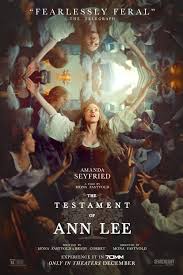
Ever since we first saw the film, Daniel Blumberg’s luminous soundtrack has been on repeat in our household and in our consciousnesses, filling our movements and our conversations with the unique kind of potency that emerges from an artistic experience that draws one to a higher level of Being.
The best art is a transmission—no, more than a transmission, an initiation, into a higher bandwidth of seeing. I told Michael last night on the way out of the theatre that what Ann Lee was doing for him, Carmélites did for me.
The Testament of Ann Lee traverses the story of the eponymous founder of the Shaker movement in America. Often confused with the Quakers, the Shakers were (and still are) a utopian community rooted in equity, simplicity, industry, and peace. Yet core to their transmission is their rejection of sexual expression, which is the main reason the movement has virtually died out.
Toward the end of the film, there is a montage number of Shaker life, play, and industry over which a Black woman, a Shaker in the Niscayuna community, sings a tune:
“Oh my pretty Mother’s home,
sweeter than the honey in the comb.”
Underneath this tune, a white Shaker sings another in counterpoint:
“I love Mother, I love her way;
I love her Gospel precepts to obey.”
The tune, “Come, Pretty Love” was a “gift song,” divinely received by a formerly enslaved woman whose freedom the Pleasant Hill community in Harrodsburg bought in the early 19th century—just across the Kentucky River from where I attended undergrad at a Wesleyan Holiness college (for which reason I was also delighted that the Methodists got a shout-out in Ann Lee, with the heroine attending one of George Whitefield’s al fresco sermons on the steps of the Collegiate Church in Manchester).
To many of us Asbury kids and others in centural Kentucky, the Shaker movement was little more than a parochial aberration with phenomenal handicrafts and some good tunes. My own music theory professor did her PhD thesis on Shaker song traditions and their influence on Southern Harmony. So I’ve been steeping in the peripheral waters of that tradition for longer than I realized.
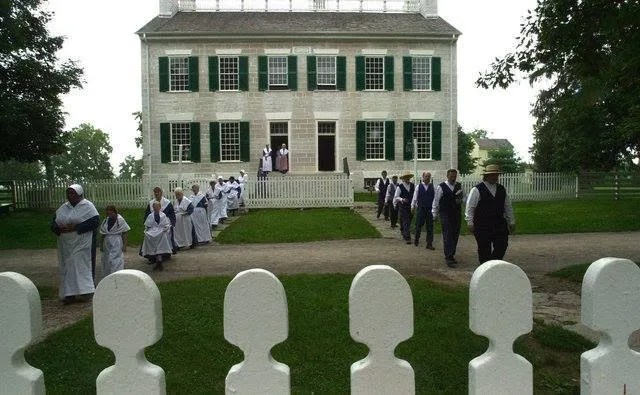
But now having sat with Ann Lee more sincerely over the last several weeks—months, really, since we’ve been waiting for this movie to drop nationwide since October—I’ve come to see more clearly that the movement Ann Lee spearheaded was/is its own kind of Wisdom school, safeguarding a unique transmission of higher Being in a container of embodied practice.
And like all Wisdom schools, it reemerges in times of great planetary ferment to offer its unique transmission. Imagine my surprise to discover that just this past year, the number of living Shakers went up for the first time in… well, a very long time. And now there is an entire swath of the Internet rumbling about the Shaker movement in a way that Mother Ann herself scarcely could have imagined.
This leads me to believe that the Shaker movement is still alive and well, but its principal field of operation is the Ancestral realm, which, I sense, is a dimension of World 24 (the Imaginal realm, in Gurdjieff/Bourgeault terminology. For more, see Eye of the Heart).
Doesn’t her movement speak to so many of our longings in this moment of historical ferment? A woman-led utopian movement based on the inherent equality of every human being, care for the earth, sustainable industry, peaceful relations across lines of difference, and grounded in an enstatic, embodied encounter with divine presence expressed in dancing?
If it weren’t for the compulsory celibacy part, I’d be in.
But, even on that note, there’s a uniquely powerful energy that emerges when eros is surrendered into kenosis in that kind of close proximity between the genders. It’s not unlike the resistance you feel when trying to push two magnets together at the same poles. It draws forth a clarity of transmission that allows for a higher level of Being to emerge. And the Shaker path certainly delivers the goods.
That said, it takes a particular temperament and training of the nervous system to be drawn to the tighter tolerances of a transmission belonging to what Cynthia Bourgeault calls the “store it up” school. Hmm, if only there were some way to train the nervous system and the inner faculties to handle the increased energy and route it toward transformation.
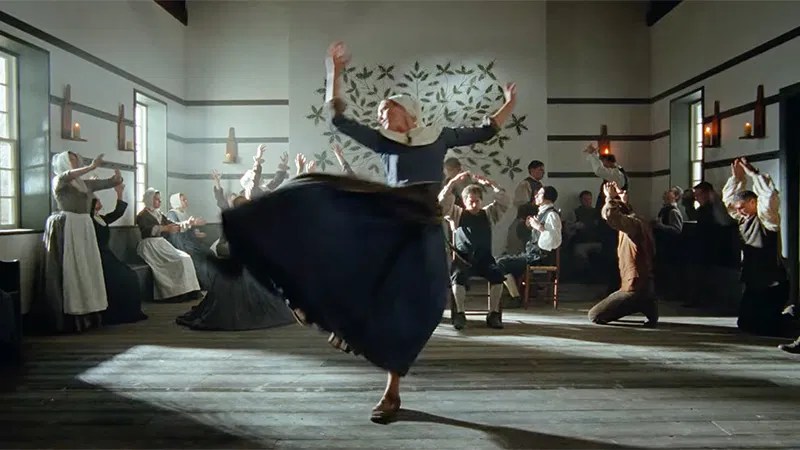
Enter Shaker “dancing,” or laboring, as they called it. While a good portion of the film’s choreography is drawn from actual Shaker dances (and a quote or two of Martha Graham’s choreography for Appalachian Spring, pictured here), other choreographic moments are dead ringers for Gurdjieff movements, drawing Being into the body through intention and intensity.
Meanwhile, the Shakers’ breathing and vocalizations are of a piece with the Sufi practice of intoning the pronominal identifier for the Mystery—hu, pronounced as “who”—with force and rhythm. Who! Who! Who! In fact, I suspect the whole spirit of Shaker danceways is of a piece with Sufi whirling (the track entitled “Worship” is an especially good whirling tune, for those interested in trying it at home).Such practices are time-tested means of attuning the inner anatomy to higher intensities of Being.
I have to wonder what could be drawn into daily practice for the average bear(/otter/pup/&c.) without a celibate vocation to work with at home. At the very least, singing, dancing, simplicity, and service. Why not? That’s so much of what we do anyway.
Which reminds me that more than a few deliciously redemptive queer story threads run through Ann Lee, too. As one Letterboxd reviewer remarked, Ann Lee is a “testament to the amazing things a diva can do with a committed gay guy by her side.”
While I’m no aspiring Shaker ascetic, there’s much I’m carrying with me from this encounter with a tradition that at once feels so alien yet so familiar. I wonder what it might prompt were I to go back and revisit the Enthusiasts of the early decades of Methodism, and how these parallel transmissions might have impelled each other’s growth and power.
But more importantly, I’m marveling at the way the Shaker transmission is resurfacing in this cultural moment with unique medicines of goodness, truth, and beauty which this historical moment sorely needs.
Go see the film. It’s so, so, so Good. And True. And Beautiful.


Leave a comment